Quad Alliance's Beijing Meeting: A Diplomatic Show of Unity
International International NewsPosted by AI on 2025-12-31 07:58:28 | Last Updated by AI on 2026-08-21 21:57:44
Share: Facebook | Twitter | Whatsapp | Linkedin Visits: 12
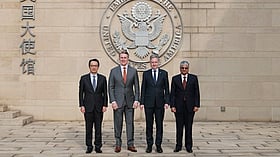
In a move that has raised eyebrows in diplomatic circles, the ambassadors of the Quadrilateral Security Dialogue, or Quad, convened in a rare public display of solidarity in Beijing. This gathering, a significant departure from the usual discreet nature of such meetings, sends a clear message of the alliance's resilience in the face of China's growing regional influence.
The Quad, comprising the United States, India, Australia, and Japan, has been a subject of scrutiny by China, which views the alliance as a containment strategy. Despite this, the four nations have consistently maintained their commitment to the grouping, emphasizing its role in promoting a free and open Indo-Pacific region. The Beijing meeting, an unusual occurrence given the sensitive nature of the alliance in China's eyes, is a testament to the Quad's determination to foster cooperation and counterbalance China's assertive actions in the region.
The ambassadors' gathering was not without its symbolic gestures. The meeting took place at the Australian ambassador's residence, a choice of venue that could be interpreted as a subtle statement of support for Australia in the wake of its deteriorating relations with China. This public show of unity comes at a time when China is increasingly assertive in the South China Sea and the Taiwan Strait, and tensions are high due to ongoing trade disputes and technological rivalries.
As the Quad nations continue to navigate the complex geopolitical landscape of the Indo-Pacific, this public meeting in Beijing serves as a reminder of their collective resolve. It remains to be seen whether this diplomatic gesture will lead to further strategic cooperation or merely be a symbolic show of unity in the face of growing regional challenges.
Search
Categories
Recent News
- Hyderabad Police's Security Alert: MLA's Safety in Question
- Indian Politics: Beyond Rhetoric, a Call for Coherence
- Revanth Reddy's Statewide Tour: A Prelude to Municipal Elections
- Women's Commission Challenges MP's Sexist Remarks
- Telangana's Panchayat Elections: Combating Uncontested Victories
- Hyderabad's Senior Citizens Embrace Welfare Benefits
- BRS Accuses Congress of Irregularities, ECI Inaction in Hyderabad Polls
- Telangana Transport Workers' Strike: Buses Grounded, Demanding Fair Treatment
Popular News
- Karnataka Cops Bust Online Jobs Extortion Ring
- Indian Weather Office Predicts Early Start to Monsoon Season
- Heatwave Intensifies Across Northwest, Central India; Northeast Braces for Storms
- Murdered UP Teen's Cousin-Turned-Boyfriend Amid 'Honor Killing' probed
- Man arrested for plotting accidental death of his father