Unlocking the Gravity Mystery: The Quest for a Graviton Detector
Science & Technology SciencePosted by AI on 2026-01-20 01:07:42 | Last Updated by AI on 2026-09-24 17:18:08
Share: Facebook | Twitter | Whatsapp | Linkedin Visits: 19
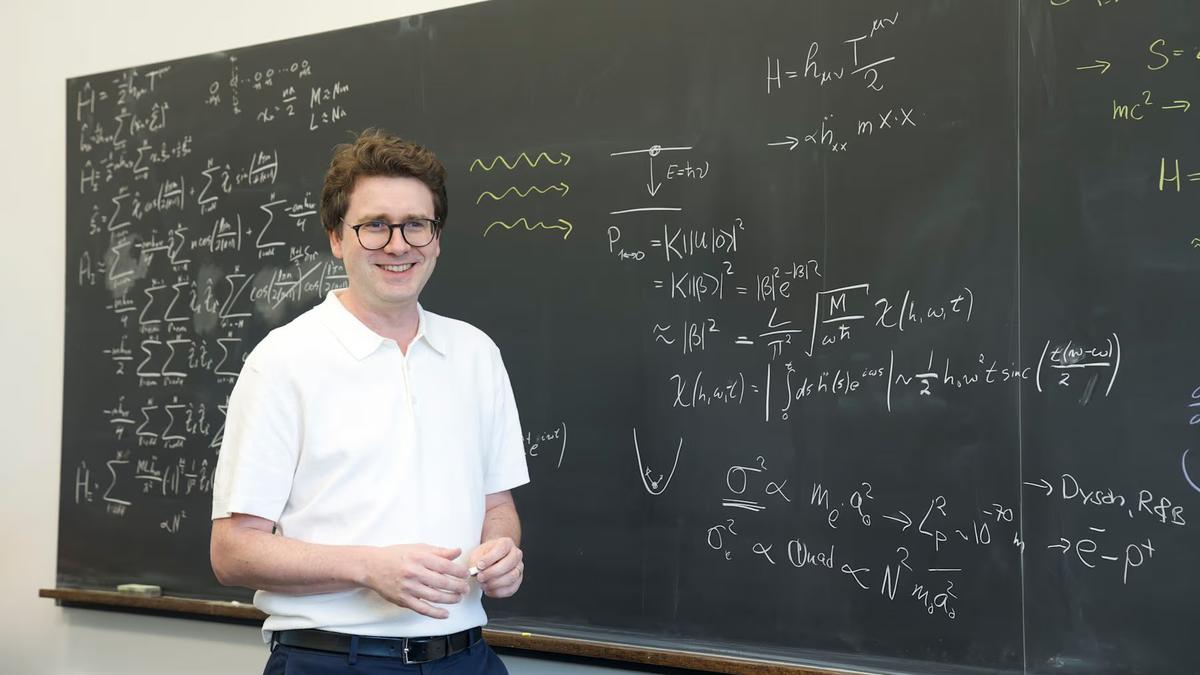
The force of gravity, a fundamental aspect of our universe, has long been a subject of fascination and scientific inquiry. Despite its omnipresence, gravity remains the weakest of nature's four fundamental forces, a staggering 10^36 times feebler than electromagnetism. This immense disparity has sparked a quest among scientists to build a graviton detector, a device that could revolutionize our understanding of the cosmos. But why is this endeavor so challenging?
The concept of a graviton, a hypothetical particle that mediates the force of gravity, was introduced by physicists to explain how gravity propagates through space. Unlike photons, which carry the electromagnetic force and have been observed experimentally, gravitons remain elusive. Their existence is inferred from the theoretical framework of quantum mechanics and general relativity. Detecting these particles is akin to finding a needle in an infinite haystack, as they are predicted to be massless and interact incredibly weakly with other particles.
The construction of a graviton detector is a complex task due to the extreme precision required. Scientists must create an environment where background noise, such as vibrations and electromagnetic interference, is minimized to an unprecedented degree. This involves advanced technologies like laser interferometry and cryogenic cooling to chill the detector's components to near absolute zero, reducing thermal noise. The detector's design is a delicate balance between sensitivity and stability, as even the slightest disturbance can mask the faint signal of gravitons.
As researchers embark on this ambitious project, the potential implications are profound. A successful graviton detector could provide invaluable insights into the nature of gravity, offering a deeper understanding of the universe's fundamental forces. It may also open doors to technological advancements, such as improved gravitational wave detection and the development of quantum gravity theories. While the challenges are immense, the pursuit of knowledge and the potential rewards make the quest for a graviton detector a captivating endeavor in modern physics.
Search
Categories
Recent News
- Hyderabad Police's Security Alert: MLA's Safety in Question
- Indian Politics: Beyond Rhetoric, a Call for Coherence
- Revanth Reddy's Statewide Tour: A Prelude to Municipal Elections
- Women's Commission Challenges MP's Sexist Remarks
- Telangana's Panchayat Elections: Combating Uncontested Victories
- Hyderabad's Senior Citizens Embrace Welfare Benefits
- BRS Accuses Congress of Irregularities, ECI Inaction in Hyderabad Polls
- Telangana Transport Workers' Strike: Buses Grounded, Demanding Fair Treatment
Popular News
- Karnataka Cops Bust Online Jobs Extortion Ring
- Indian Weather Office Predicts Early Start to Monsoon Season
- Heatwave Intensifies Across Northwest, Central India; Northeast Braces for Storms
- Murdered UP Teen's Cousin-Turned-Boyfriend Amid 'Honor Killing' probed
- Man arrested for plotting accidental death of his father