India Recognised as Rinderpest Holding Facility
Current Affairs International IssuesPosted by NewAdmin on 2025-06-19 09:10:31 |
Share: Facebook | Twitter | Whatsapp | Linkedin Visits: 120
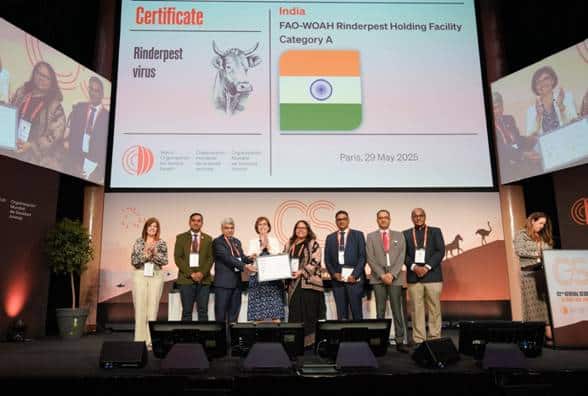
India has marked a significant milestone in global animal health with the ICAR-National Institute of High Security Animal Diseases (NIHSAD) in Bhopal earning recognition as a Category A Rinderpest Holding Facility (RHF). This prestigious designation was announced on 29th May 2025 during the 92nd General Session of the World Organisation for Animal Health (WOAH) held in Paris.
Rinderpest, once known as cattle plague, was a devastating and highly contagious viral disease that targeted ruminants, primarily cattle. It caused widespread livestock deaths and threatened global food security until it was officially declared eradicated in 2011, thanks to the Global Rinderpest Eradication Programme initiated by the Food and Agriculture Organisation (FAO) in 1994.
Despite its eradication, the virus remains a biosecurity concern. To prevent any accidental re-emergence, Rinderpest Virus-Containing Material (RVCM) is stored in specially designated high-security laboratories worldwide, known as RHFs. These facilities follow strict global guidelines to ensure the virus remains contained, eliminating any risk of future outbreaks.
ICAR-NIHSAD has served as India’s national repository for RVCM since 2012 and operates as a high-containment BSL-3 laboratory. It also functions as a reference centre for avian influenza. India submitted its application for RHF status in 2019, and a rigorous joint inspection by international experts in March 2025 confirmed that NIHSAD meets all necessary biosafety standards and emergency protocols.
With this designation, India joins an elite group of only six countries hosting RHF facilities, highlighting the country’s growing leadership in the fields of animal health and biosecurity. This achievement demonstrates India’s commitment to upholding global standards in managing and controlling infectious animal diseases.
Looking ahead, the WOAH committee has encouraged India to expand its role by actively participating in vaccine seed material management, a move that could help India secure a Category B status in the coming years. The recognition of NIHSAD as a Category A RHF underscores India’s dedication to contributing to global animal disease surveillance and control, reinforcing its position as a key player in safeguarding animal and public health worldwide.
Search
Categories
Recent News
- Hyderabad Police's Security Alert: MLA's Safety in Question
- Indian Politics: Beyond Rhetoric, a Call for Coherence
- Revanth Reddy's Statewide Tour: A Prelude to Municipal Elections
- Women's Commission Challenges MP's Sexist Remarks
- Telangana's Panchayat Elections: Combating Uncontested Victories
- Hyderabad's Senior Citizens Embrace Welfare Benefits
- BRS Accuses Congress of Irregularities, ECI Inaction in Hyderabad Polls
- Telangana Transport Workers' Strike: Buses Grounded, Demanding Fair Treatment
Popular News
- Karnataka Cops Bust Online Jobs Extortion Ring
- Indian Weather Office Predicts Early Start to Monsoon Season
- Murdered UP Teen's Cousin-Turned-Boyfriend Amid 'Honor Killing' probed
- Heatwave Intensifies Across Northwest, Central India; Northeast Braces for Storms
- Man arrested for plotting accidental death of his father