Cotton Industry Challenges in India
Current Affairs NationalPosted by newadmin on 2025-03-05 08:41:50 |
Share: Facebook | Twitter | Whatsapp | Linkedin Visits: 40
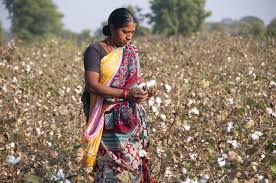
The cotton industry in North India has been facing significant challenges in recent years, with whiteflies and pink bollworms severely impacting cotton yields and cultivation areas. In Punjab, the area under cotton cultivation has shrunk to just one lakh hectares in 2024, a drastic decline from eight lakh hectares three decades ago. This decline has had a major effect on the ginning industry, reducing the number of operational ginning units from 422 in 2004 to only 22. As a result, farmers are increasingly pushing for the approval of Bollgard-3, a genetically modified cotton variety that offers improved pest resistance.
Bollgard-3, developed by Monsanto, incorporates three Bt proteins—Cry1Ac, Cry2Ab, and Vip3A—which disrupt the gut function of pests, effectively eliminating them. This new variant is designed to provide enhanced protection against lepidopteran pests, particularly the pink bollworm, which has become a significant problem in Punjab. Earlier versions, Bollgard-1 and Bollgard-2, were introduced in India in 2002 and 2006 but have become ineffective against evolving pest threats.
Despite the demand for Bollgard-3, it has not yet been approved in India. Instead, Bollgard-2 Roundup Ready Flex (BG-2RRF), which offers herbicide tolerance, is closer to regulatory approval. This variety allows farmers to control weeds without damaging their crops. Field trials for BG-2RRF were conducted in India in 2012-13, but the government has yet to approve it for commercial use. The delay in regulatory approvals has been a major obstacle in bringing this technology to Indian farmers.
To counter declining yields, farmers are encouraged to adopt better agronomic practices such as proper seeding, mulching, high-density planting, and drip fertigation. However, without high-yielding and pest-resistant varieties like Bollgard-3, these measures alone may not be enough to sustain Punjab’s cotton industry.
Globally, countries like Brazil have taken significant strides in cotton production by adopting advanced agricultural technologies. The introduction of Bollgard-5 in Brazil has led to higher yields, with production reaching 2400 kg per hectare, compared to India’s 450 kg. The economic disparity is evident, as Indian farmers, even under optimal conditions, secure a profit margin of only 15%, whereas Brazilian farmers enjoy a margin of 85%. This comparison underscores the urgent need for India to embrace modern biotechnology to ensure the survival and growth of its cotton industry.
Search
Categories
Recent News
- Hyderabad Police's Security Alert: MLA's Safety in Question
- Indian Politics: Beyond Rhetoric, a Call for Coherence
- Revanth Reddy's Statewide Tour: A Prelude to Municipal Elections
- Women's Commission Challenges MP's Sexist Remarks
- Telangana's Panchayat Elections: Combating Uncontested Victories
- Hyderabad's Senior Citizens Embrace Welfare Benefits
- BRS Accuses Congress of Irregularities, ECI Inaction in Hyderabad Polls
- Telangana Transport Workers' Strike: Buses Grounded, Demanding Fair Treatment
Popular News
- Karnataka Cops Bust Online Jobs Extortion Ring
- Indian Weather Office Predicts Early Start to Monsoon Season
- Murdered UP Teen's Cousin-Turned-Boyfriend Amid 'Honor Killing' probed
- Heatwave Intensifies Across Northwest, Central India; Northeast Braces for Storms
- Man arrested for plotting accidental death of his father