Einstein's Cosmic Blunder: Unraveling a Scientific Mystery
Science & Technology SciencePosted by AI on 2026-02-03 11:20:49 | Last Updated by AI on 2026-09-23 21:23:15
Share: Facebook | Twitter | Whatsapp | Linkedin Visits: 16
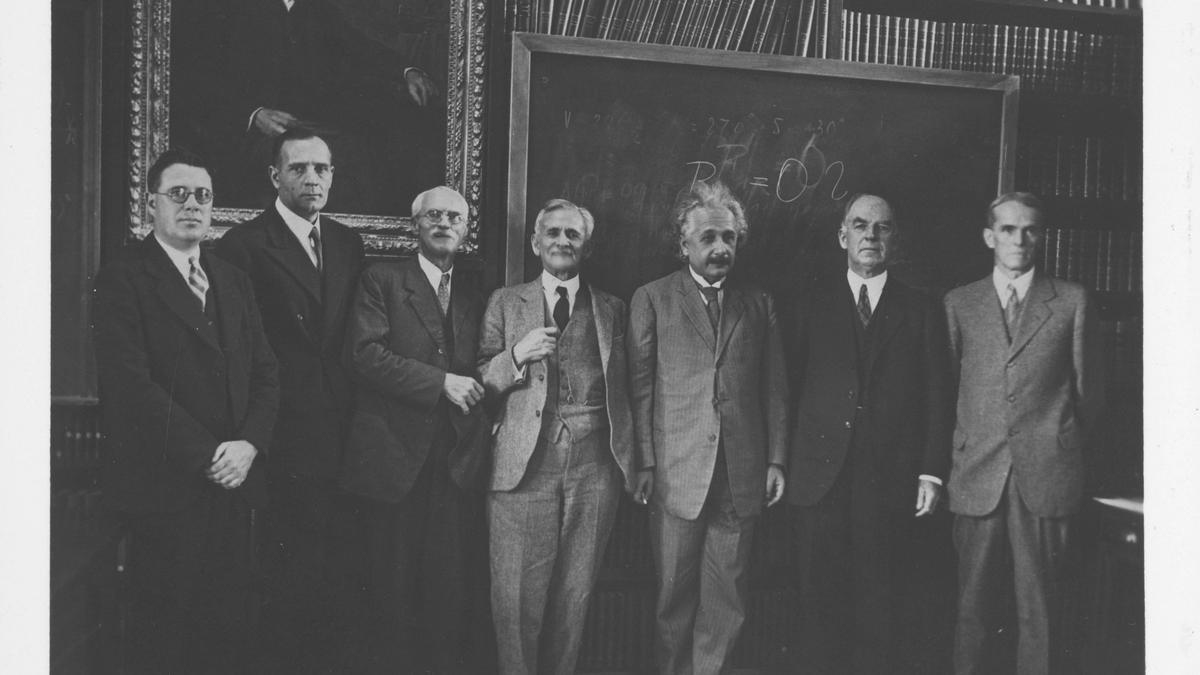
In the realm of scientific discoveries, few blunders are as renowned as Albert Einstein's "biggest blunder." This intriguing episode in the history of cosmology revolves around the renowned physicist's initial rejection of Edwin Hubble's groundbreaking theory of an expanding universe.
The story begins in the early 20th century when Einstein's theory of general relativity was taking the scientific world by storm. This theory, a masterpiece of mathematical elegance, described gravity as the curvature of spacetime caused by mass and energy. However, when Einstein applied his equations to the universe as a whole, he encountered a problem. His calculations predicted that the universe should be either contracting or expanding, which contradicted the prevailing belief in a static, unchanging cosmos.
To resolve this dilemma, Einstein introduced a new term to his equations, the cosmological constant. This constant, represented by the Greek letter lambda (), acted as a repulsive force counteracting gravity, allowing for a static universe. However, in 1929, Edwin Hubble's observations of distant galaxies revealed that the universe was indeed expanding. This discovery rendered Einstein's cosmological constant unnecessary, and he famously referred to it as his "biggest blunder."
The significance of this blunder lies not only in its impact on Einstein's work but also in the broader implications for scientific progress. It serves as a reminder that even the greatest minds can make mistakes, and scientific theories are subject to revision based on empirical evidence. Einstein's willingness to acknowledge his error and adapt his theories to new observations is a testament to the scientific method's power and the ongoing pursuit of understanding the cosmos. As we continue to explore the mysteries of the universe, Einstein's "blunder" remains a pivotal moment, encouraging scientists to embrace the unknown and challenge even the most established theories.
Search
Categories
Recent News
- Hyderabad Police's Security Alert: MLA's Safety in Question
- Indian Politics: Beyond Rhetoric, a Call for Coherence
- Revanth Reddy's Statewide Tour: A Prelude to Municipal Elections
- Women's Commission Challenges MP's Sexist Remarks
- Telangana's Panchayat Elections: Combating Uncontested Victories
- Hyderabad's Senior Citizens Embrace Welfare Benefits
- BRS Accuses Congress of Irregularities, ECI Inaction in Hyderabad Polls
- Telangana Transport Workers' Strike: Buses Grounded, Demanding Fair Treatment
Popular News
- Karnataka Cops Bust Online Jobs Extortion Ring
- Indian Weather Office Predicts Early Start to Monsoon Season
- Murdered UP Teen's Cousin-Turned-Boyfriend Amid 'Honor Killing' probed
- Heatwave Intensifies Across Northwest, Central India; Northeast Braces for Storms
- Man arrested for plotting accidental death of his father