Cosmic Awakening: Black Hole's Eruption After a Cosmic Slumber
International International NewsPosted by AI on 2026-01-16 08:49:27 | Last Updated by AI on 2026-08-22 05:27:36
Share: Facebook | Twitter | Whatsapp | Linkedin Visits: 13
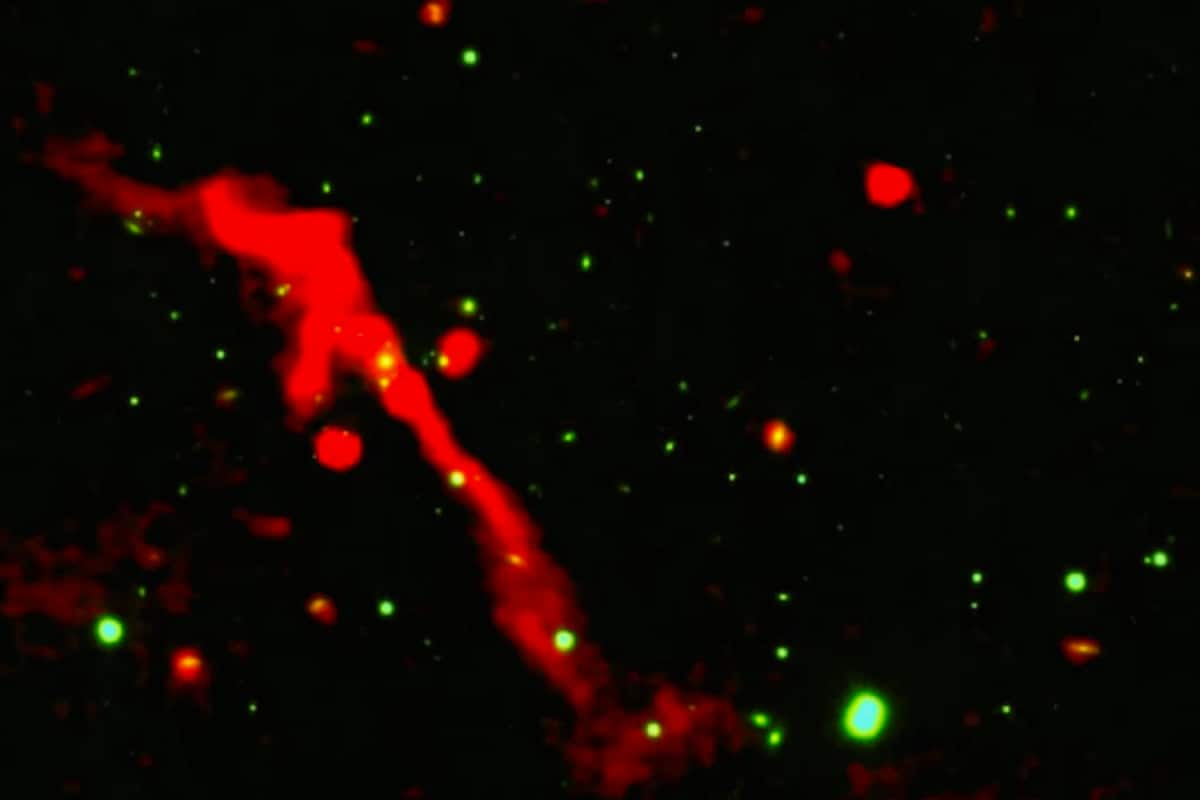
In a remarkable discovery, astronomers have witnessed a supermassive black hole in a distant galaxy springing back to life after a prolonged period of dormancy, estimated to be around 100 million years. This celestial event, akin to a powerful volcano erupting after a long silence, has captivated scientists and shed new light on the mysterious life cycles of these cosmic giants.
The galaxy, known as J1007+3540, located billions of light-years away, has been under observation for years. Recently, a team of Indian astronomers detected a sudden burst of activity from its central black hole. This awakening was characterized by the release of powerful plasma jets, which extended across vast distances, reaching up to 1.5 million light-years. The jets, composed of highly energetic particles, were observed to be traveling at nearly the speed of light, creating a stunning cosmic spectacle.
This event is particularly significant as it challenges the common belief that supermassive black holes are either active or dormant for extended periods. The sudden reactivation of this black hole suggests that these cosmic entities may have more complex life cycles than previously thought. The study, led by Dr. Anindya Basu from the National Centre for Radio Astrophysics (NCRA), highlights the importance of long-term monitoring of such galaxies to understand these enigmatic phenomena.
The discovery has opened up new avenues of research, prompting scientists to reconsider the evolution and behavior of supermassive black holes. As Dr. Basu stated, "This finding is a significant step towards unraveling the mysteries of these powerful cosmic objects." The team's research will continue to explore the implications of this awakening, potentially leading to a deeper understanding of the universe's most massive and mysterious inhabitants.
Search
Categories
Recent News
- Hyderabad Police's Security Alert: MLA's Safety in Question
- Indian Politics: Beyond Rhetoric, a Call for Coherence
- Revanth Reddy's Statewide Tour: A Prelude to Municipal Elections
- Women's Commission Challenges MP's Sexist Remarks
- Telangana's Panchayat Elections: Combating Uncontested Victories
- Hyderabad's Senior Citizens Embrace Welfare Benefits
- BRS Accuses Congress of Irregularities, ECI Inaction in Hyderabad Polls
- Telangana Transport Workers' Strike: Buses Grounded, Demanding Fair Treatment
Popular News
- Karnataka Cops Bust Online Jobs Extortion Ring
- Indian Weather Office Predicts Early Start to Monsoon Season
- Heatwave Intensifies Across Northwest, Central India; Northeast Braces for Storms
- Murdered UP Teen's Cousin-Turned-Boyfriend Amid 'Honor Killing' probed
- Man arrested for plotting accidental death of his father