Discovery of Ancient Astrolabe at Raigad Fort
Current Affairs International IssuesPosted by newadmin on 2025-06-04 08:45:51 |
Share: Facebook | Twitter | Whatsapp | Linkedin Visits: 133
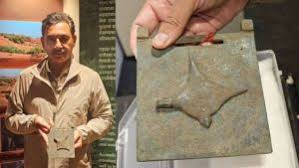
Recent archaeological excavations at Raigad Fort have led to the remarkable discovery of an ancient astrolabe, referred to as the ‘yantraraj’. This significant find was made by the Archaeological Survey of India (ASI) in collaboration with the Raigad Development Authority. The excavations, which were conducted over several years, focused on multiple sites within the fort and brought to light structures and artefacts from the time of Chhatrapati Shivaji Maharaj.
Raigad Fort, located in North Konkan, Maharashtra, stands atop the Sahyadri hills and is flanked by deep valleys on three sides. Known for its strategic location and difficult terrain, the fort is accessible only through a steep, narrow path. Originally built by Chandraraoji More, a local feudal lord of Jawali, it was captured by Shivaji in 1656 CE and renamed from Rairi to Raigad, meaning “royal fort.” It later served as the capital of the Maratha Empire during Shivaji’s reign. Over the centuries, the fort changed hands several times — falling to Fateh Khan of the Ahmadnagar Sultanate in 1707 CE, returning to the Marathas until 1813 CE, and eventually being captured by the British in 1818 after intense cannon bombardment. Due to its formidable construction and location, the British referred to it as the “Gibraltar of the East.”
The fort houses several important architectural structures, including grand entry gates like the Chitta Darwaja and Maha Darwaja, the latter flanked by towering bastions. The Palkhi Darwaja served as a special entrance for queens, while the Ranivasa consisted of a row of chambers for royal women. The Nagarkhana Darwaja faces the royal throne and features a three-storey design. Public court sessions were held at the Raj Sadar, a hall constructed for official meetings. In terms of resources and worship, the fort includes the Ganga Sagar, a man-made lake, and the Jagadishwar Mandir, a temple dedicated to Shiva that is still active today. The tomb of Shivaji Maharaj, built after his death in 1680 CE, is also located here.
Excavations were conducted over a span of three to four years at approximately 10 to 12 locations. These included the ropeway upper station, Kushavarta lake, and the marketplace near the Jagdishwar temple. The aim was to uncover artefacts from Shivaji Maharaj’s era, and it was near a historic mansion above Kushavarta lake that the astrolabe was unearthed.
The astrolabe itself is made of a copper-bronze alloy and has a rectangular shape. It features inscriptions on its surface in both Sanskrit and Devanagari script. Engravings of two animals, which appear to be a tortoise or snake, are etched onto the device, with the terms “mukh” (head) and “poonchh” (tail) indicating directions. These markings suggest it was likely used for determining north-south orientation, a critical function for navigation and astronomy.
This astrolabe is believed to date back to Shaka 1519, which corresponds to the year 1597 in the Gregorian calendar. Given the timeline, it likely remained in use during major events such as the fort’s renovation in 1656 and Shivaji’s coronation in 1674. During this era, astrolabes were vital tools for seafarers and astrologers who relied on them for navigation and astronomical calculations.
The discovery is of profound historical importance, revealing the advanced understanding of astronomy during the Maratha Empire. It also implies that the fort’s construction and planning may have been guided by astronomical principles. Sambhajiraje Chhatrapati, who heads the Raigad Development Authority, emphasized that the astrolabe could shed light on the administrative and scientific practices followed during Shivaji’s reign.
Ongoing conservation efforts at Raigad Fort have resulted in the recovery of various significant items, such as Shivrai coins, clay and glass utensils, traditional weapons, and oil lamps. These artefacts are currently curated by the ASI’s Mumbai Circle. The astrolabe will soon undergo chemical treatment to preserve its structure and is slated to be displayed in a Mumbai museum for public viewing.
Looking ahead, further research into this ancient instrument is expected to provide deeper insights into Maratha advancements in both naval and astronomical fields. Scholars are hopeful that the astrolabe will reveal new information about navigation techniques and governance systems used during Shivaji Maharaj’s time, potentially rewriting some aspects of our understanding of 17th-century scientific knowledge.
Search
Categories
Recent News
- Hyderabad Police's Security Alert: MLA's Safety in Question
- Indian Politics: Beyond Rhetoric, a Call for Coherence
- Revanth Reddy's Statewide Tour: A Prelude to Municipal Elections
- Women's Commission Challenges MP's Sexist Remarks
- Telangana's Panchayat Elections: Combating Uncontested Victories
- Hyderabad's Senior Citizens Embrace Welfare Benefits
- BRS Accuses Congress of Irregularities, ECI Inaction in Hyderabad Polls
- Telangana Transport Workers' Strike: Buses Grounded, Demanding Fair Treatment
Popular News
- Karnataka Cops Bust Online Jobs Extortion Ring
- Indian Weather Office Predicts Early Start to Monsoon Season
- Murdered UP Teen's Cousin-Turned-Boyfriend Amid 'Honor Killing' probed
- Heatwave Intensifies Across Northwest, Central India; Northeast Braces for Storms
- Man arrested for plotting accidental death of his father