Battle of Buxar: British Victory Solidifies Control Over Bengal
History Indian HistoryPosted by NewAdmin on 2025-01-29 09:58:08 |
Share: Facebook | Twitter | Whatsapp | Linkedin Visits: 70
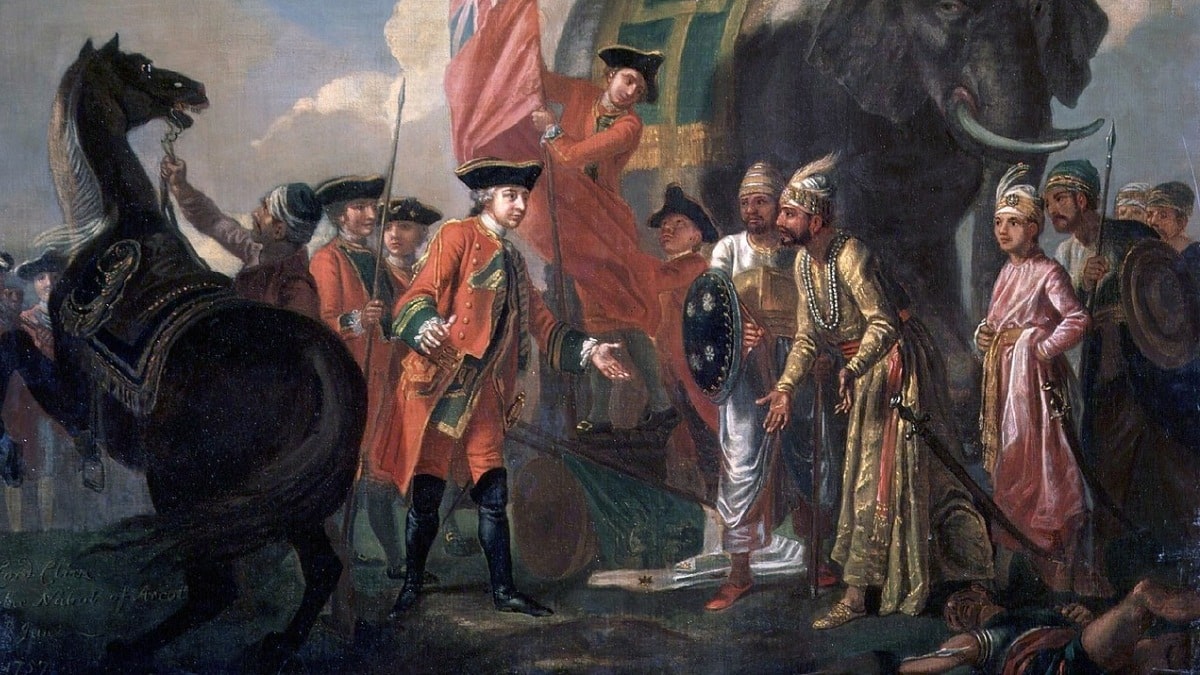
The Battle of Buxar, fought on October 22, 1764, was a pivotal confrontation that solidified British control over Bengal, marking a significant chapter in India's colonial history. The battle took place near the town of Buxar, located on the banks of the Ganges River in present-day Bihar, and saw British East India Company forces decisively defeat a combined army consisting of the Mughal Emperor Shah Alam II, the Nawab of Oudh (Shuja-ud-Daula), and the Nawab of Bengal (Mir Qasim).
The roots of the battle lay in the complex political and military dynamics of 18th-century India. After the victory at Plassey in 1757, the British East India Company had gained significant influence in Bengal, but the region was still embroiled in political instability and military unrest. Mir Qasim, the Nawab of Bengal, had initially cooperated with the British but soon grew disillusioned with the Company's increasing control and economic demands. In an attempt to reclaim sovereignty and control over Bengal, Mir Qasim allied with the Mughal Emperor and Shuja-ud-Daula, the Nawab of Oudh, and began preparing to challenge the British.
The British forces, led by Major Hector Munro, faced a well-coordinated alliance of forces from the Mughal Empire, Oudh, and Bengal. Despite being outnumbered, the British forces, bolstered by disciplined European soldiers and a well-trained artillery unit, decisively defeated the combined enemy forces. The victory was a testament to the superior military tactics and leadership of the British East India Company.
The consequences of the Battle of Buxar were far-reaching. The victory cemented British dominance over Bengal, enabling them to effectively control its resources and economy. The Treaty of Allahabad in 1765, which followed the battle, saw the Mughal Emperor Shah Alam II formally granting the British East India Company the Diwani rights (the right to collect revenue) over Bengal, Bihar, and Orissa. This treaty not only gave the British a legal basis for their control over Bengal but also marked the beginning of British political and administrative dominance in India.
In essence, the Battle of Buxar played a crucial role in laying the foundations for the British Empire's eventual dominance over India, setting the stage for further expansion and the consolidation of British rule in the subcontinent.
Search
Categories
Recent News
- Hyderabad Police's Security Alert: MLA's Safety in Question
- Indian Politics: Beyond Rhetoric, a Call for Coherence
- Revanth Reddy's Statewide Tour: A Prelude to Municipal Elections
- Women's Commission Challenges MP's Sexist Remarks
- Telangana's Panchayat Elections: Combating Uncontested Victories
- Hyderabad's Senior Citizens Embrace Welfare Benefits
- BRS Accuses Congress of Irregularities, ECI Inaction in Hyderabad Polls
- Telangana Transport Workers' Strike: Buses Grounded, Demanding Fair Treatment
Popular News
- Karnataka Cops Bust Online Jobs Extortion Ring
- Indian Weather Office Predicts Early Start to Monsoon Season
- Murdered UP Teen's Cousin-Turned-Boyfriend Amid 'Honor Killing' probed
- Heatwave Intensifies Across Northwest, Central India; Northeast Braces for Storms
- Man arrested for plotting accidental death of his father