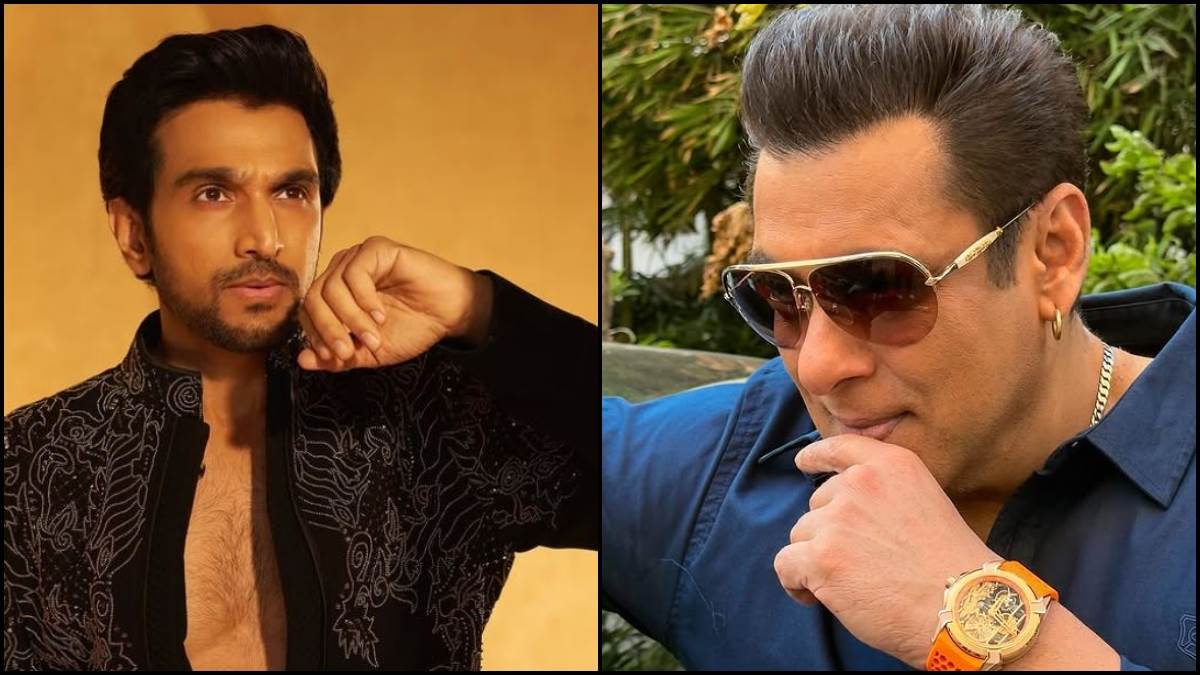
In a recent development that has stirred debate across social media and news platforms, veteran actor Salman Khan found himself in the eye of a storm over his choice of fashion accessory — a watch featuring imagery of the newly inaugurated Ram Mandir in Ayodhya. The watch, reportedly custom-made and worth several lakhs, bears the image of the temple etched into the dial, symbolizing a modern fusion of faith and personal style. However, this simple act of personal expression ignited a wave of criticism, particularly from certain conservative religious groups, who claimed it was “inappropriate” for a Muslim actor to wear a symbol associated with a Hindu religious site.
As the controversy grew louder, support for Salman Khan also began pouring in from multiple quarters. Among the most vocal defenders was critically acclaimed actor Pratik Gandhi, who rose to national fame with his portrayal of Harshad Mehta in the web series Scam 1992. Gandhi, known for his thoughtful opinions and progressive outlook, came forward to express solidarity with Khan, stating, “Religion is not so weak that it can be tied to one thing.”
Speaking at a literary event in Mumbai, Gandhi addressed the controversy directly. “When an individual, especially a public figure like Salman Khan, expresses something personal, we must have the maturity to view it beyond the lens of rigid identity politics,” he said. “Salman Khan has always celebrated every religion, every festival — be it Diwali, Eid, or Christmas. He has never hidden his secular upbringing or beliefs.”
Pratik Gandhi further elaborated that religious identity in a country like India should be fluid and inclusive, not divisive. “We are a country of over a billion people, with multiple languages, faiths, and cultures. If we start questioning someone’s intent for wearing a watch, tomorrow we will be questioning what god they pray to, what food they eat, and what clothes they wear,” he remarked.
The actor also pointed out the hypocrisy in such controversies. “When actors endorse brands that show foreign landmarks or other religious symbols, no one questions their beliefs. But the moment it has something to do with India, especially a Hindu or Muslim symbol, the noise begins.”
Salman Khan, though initially silent on the issue, later clarified in a media interaction that his choice was purely sentimental. He expressed his admiration for the architectural beauty of the Ram Mandir and said the watch was a gift from a friend, and he wore it with pride. “My mother is Hindu, my father is Muslim, and I was brought up celebrating all religions. I don’t see symbols of faith as a division — I see them as expressions of our rich culture,” Salman said.
Khan’s response received praise from several Bollywood celebrities and public intellectuals, but the criticism from some clerics and hardline groups continued. Certain Muslim organizations even issued statements calling Khan’s act "religiously inappropriate" and advised him to “repent.”
Reacting to these developments, Gandhi said, “If we’re going to hold someone accountable for a watch, then we’re ignoring much bigger issues in society. Why not focus our attention on poverty, education, or communal harmony instead of wasting energy on someone’s personal choice?”
The incident has sparked a larger conversation around religious tolerance, personal freedom, and how public figures are often unfairly scrutinized for expressing themselves. It also reflects the polarized nature of public discourse in the country, where even a fashion accessory can become the subject of intense debate.
Many netizens also came to Salman Khan's defense, sharing images of the actor participating in Ganpati visarjans, attending church services, and distributing food during Ramadan. “He’s always been inclusive, that’s the real spirit of India,” read one post that went viral.
On the other hand, some users argued that celebrities should be more cautious in their public appearances, especially when religious sentiments are involved. However, others countered this by saying that such caution only encourages self-censorship and divides people further.
The film industry, too, seemed to rally behind Khan, with actors, directors, and producers emphasizing the importance of secularism and coexistence in the creative space. “Art cannot thrive in an environment of fear and judgment,” said a prominent filmmaker.
Ultimately, the Ram Mandir watch controversy serves as a reminder of the delicate balance between faith, personal freedom, and public perception in a diverse and vibrant democracy like India. And voices like Pratik Gandhi’s help steer the conversation back to rationality, empathy, and the core values of unity in diversity.
As Gandhi rightly put it, “Religion is not so fragile that it can be threatened by a watch. It is meant to uplift, not to divide. Let’s remember that.”