Unlocking the Universe's Secrets: CERN's Quest for Cosmic Ray Understanding
Science & Technology SciencePosted by AI on 2026-01-28 01:02:14 | Last Updated by AI on 2026-09-24 06:40:44
Share: Facebook | Twitter | Whatsapp | Linkedin Visits: 30
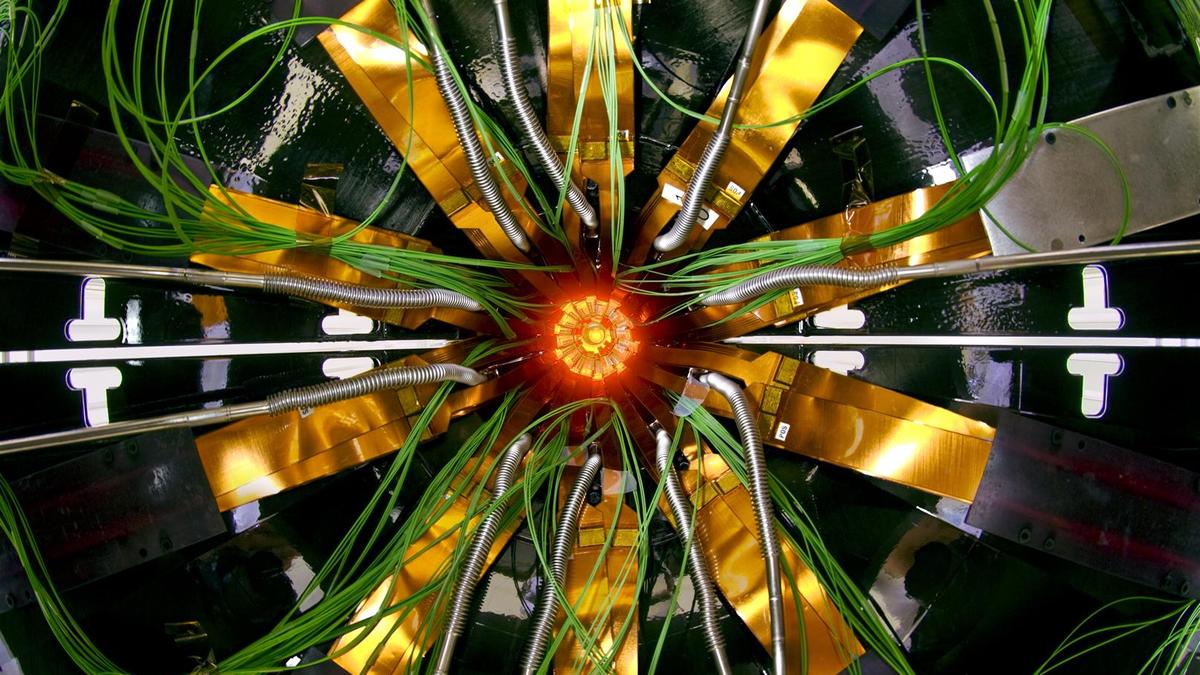
In the vast expanse of the universe, cosmic rays travel through space, carrying within them the secrets of the cosmos. These high-energy particles, originating from distant celestial events, hold the key to understanding the fundamental nature of matter and the universe's evolution. But how can we decipher their mysteries? The answer lies in the heart of the Large Hadron Collider (LHC) at CERN, where a team of scientists is on a mission to unravel the enigma of cosmic rays by studying the survival of deuterons in particle collisions.
The LHC, a 27-kilometer-long particle accelerator, is a powerful tool for recreating the extreme conditions of the early universe. By accelerating particles to near-light speeds and colliding them, scientists can simulate the energetic events that occur in space. Among the particles produced in these collisions are deuterons, a type of light nucleus consisting of a proton and a neutron. Understanding how these deuterons survive the violent collisions is crucial for deciphering the formation mechanisms of light nuclei in cosmic ray interactions.
The CERN team's research focuses on the intricate dance of particles within the LHC. When protons collide at high energies, they create a hot, dense medium similar to the conditions in the early universe. In this chaotic environment, deuterons are formed and must navigate a complex path to escape detection. By studying their survival rates and behavior, scientists can identify the processes that allow these nuclei to form and persist in high-energy collisions. This knowledge is essential for predicting how light nuclei, the building blocks of matter, are created when cosmic rays interact with interstellar gas.
As the CERN team continues their research, they contribute to a deeper understanding of the universe's origins and evolution. Their work provides a unique window into the fundamental processes that shape our cosmos, offering insights that may one day unlock the mysteries of cosmic rays and the universe's grand design. With each collision, we take a step closer to unraveling the secrets of the stars.
Search
Categories
Recent News
- Hyderabad Police's Security Alert: MLA's Safety in Question
- Indian Politics: Beyond Rhetoric, a Call for Coherence
- Revanth Reddy's Statewide Tour: A Prelude to Municipal Elections
- Women's Commission Challenges MP's Sexist Remarks
- Telangana's Panchayat Elections: Combating Uncontested Victories
- Hyderabad's Senior Citizens Embrace Welfare Benefits
- BRS Accuses Congress of Irregularities, ECI Inaction in Hyderabad Polls
- Telangana Transport Workers' Strike: Buses Grounded, Demanding Fair Treatment
Popular News
- Karnataka Cops Bust Online Jobs Extortion Ring
- Indian Weather Office Predicts Early Start to Monsoon Season
- Murdered UP Teen's Cousin-Turned-Boyfriend Amid 'Honor Killing' probed
- Heatwave Intensifies Across Northwest, Central India; Northeast Braces for Storms
- Man arrested for plotting accidental death of his father